
Notion Bug Tracker Template (Free) for Website Projects
By GiveFeedback.ioUpdated 8 min readEspañol

A Notion bug tracker template gives agencies and freelancers who already run their projects in Notion a ready-made place for website bugs and client feedback: no new tool for the team, and every issue sits next to the brief, the sitemap and the meeting notes. Start from the free template, which imports with the properties and views already set up, and let client feedback fill it automatically instead of copying screenshots out of emails.
What is a Notion bug tracker?
A Notion bug tracker is a Notion database in which every bug, change request or piece of feedback is one page, and each page has properties (Status, Type, Priority, Page URL, Assignee) that you can filter, sort and group. Notion has no special bug feature; the database is the tracker, which is why a good template matters.
For website projects this is usually enough. You don't need sprints, release versions or code links to fix "the hero image is blurry on high-resolution screens". You need to know what is broken, where, who is on it and whether it's done. A Notion issue tracker template and a bug tracker template are the same thing for this purpose: a database with the right properties and views.
How do you import the Notion bug tracker template?
Download the CSV above, then in Notion go to Settings, Import and CSV (or type /csv on the page where the tracker should live), upload the file and create a new database. Map each column to the right property type, rename the database after the client project and delete the example rows once the team has seen how they work.
- Import the file: Settings, Import, CSV, or type
/csvon a page. Notion's guide to importing data shows each screen. - Map the columns: Status to a Status or Select property, Type and Priority to Select, Page URL to URL, Assignee to Person, Date reported to Date. Keep Name as the title property.
- Name the database: for example "Website feedback, Client name". One database per client project keeps sharing simple; one shared database with a Project property works if you run many small projects.
- Clear the examples: the five rows cover every status and feedback type. Delete them before the first review round.
Which properties should a Notion bug tracker have?
A short list is enough: a title, Status, Type, Priority, Page URL, Browser, OS and Screen size, Reported by and Assignee. Each one answers a question the developer would otherwise ask. Keep the list short, because every property is a field someone has to fill, and delete any property nobody uses after two weeks.
| Property | Notion type | Example values | Why |
|---|---|---|---|
| Name | Title | "Contact button overlaps footer on small laptops" | One line that describes the problem |
| Status | Status or Select | Open, In progress, Ready for review, Resolved | Drives the board view |
| Type | Select | Bug, Proposal, Recommendation, Feature | Separates real bugs from requests; matches GiveFeedback.io's default types |
| Priority | Select | High, Medium, Low | Decides what to fix before launch |
| Page URL | URL | https://staging.example.com/contact/ | Where the problem is |
| Browser, OS, Screen size | Text | Chrome 129, Windows 11, 1366x768 | So the developer can reproduce it |
| Reported by | Text | Client | Who to ask for clarification |
| Assignee | Person | Your developer or designer | Who owns it |
| Date reported | Date | 2026-10-07 | For items added by hand; add Notion's Created time property for the rest |
Which views make a Notion issue tracker work?
Four views turn the database into a working tracker: a board by status for daily work, a triage table with the new items, a "my tasks" view per person and a client review view filtered to items ready for review. Add Page URL and Priority to the board cards so you can see them without opening each page.
- Board by Status: the default view for daily work, with columns Open, In progress, Ready for review and Resolved. Drag cards as they move.
- Triage: a table filtered to Status = Open, sorted by Created time, newest first. One person goes through it daily and sets Type, Priority and Assignee.
- My tasks: a board or list filtered to Assignee = Me, hiding Resolved. Each developer bookmarks it.
- Client review: filtered to Status = Ready for review. Share it with the client as a guest so they can confirm fixes.
Why do Notion bug trackers fail?
Most Notion bug trackers fail at the intake, not the database. Feedback keeps arriving as an email with six screenshots, a voice note and a comment in a PDF, so someone has to retype every item into Notion and then ask the client which page and which browser. Asking the client to use Notion directly rarely works either.
Without an intake tool, someone on your team has to:
- Read the email: and work out how many separate issues it contains.
- Save each screenshot: if there is one.
- Create a page per issue: and paste the screenshot and the text.
- Ask the client: which page, which browser and what they expected.
That's about five minutes per issue, and for a 40-comment review round it's most of an afternoon. Clients asked to use Notion need an account, don't know your properties and still have to take and mark up screenshots by hand.
How do you send website feedback to Notion automatically?
Add a feedback button to the website with GiveFeedback.io and connect its Notion integration. Clients click the button, mark up a screenshot of the page and send it, and each report is created as a new page in your Notion database with the title, the screenshot, the description, the feedback type, the browser data and a link back to the full report.
How to connect it
- Create a project: sign up free at GiveFeedback.io and add your site's URL.
- Install the button: paste the script into the site's
<head>; the install guides cover WordPress, Shopify, Wix, Squarespace, PrestaShop and Google Tag Manager. - Choose Notion: in the project, open Integrations and choose Notion.
- Authorize access: sign in to Notion and authorize GiveFeedback.io. When Notion asks which pages to share, include the feedback database.
- Pick the database: select the database where reports should go. Its title property must be called Name, as it is in the template.
What arrives in Notion
The integration writes the report title to the Name property and the rest into the page body:
- Screenshot: the image the reporter marked up, at the top of the page.
- Description: what the reporter wrote.
- Feedback information: the status when it was sent, the project and the feedback type (Bug, Proposal, Recommendation, Feature or your own types).
- Browser data: screen resolution, operating system, browser and version, language and time zone.
- Link back: to the report in the GiveFeedback.io dashboard, which also holds the page URL.
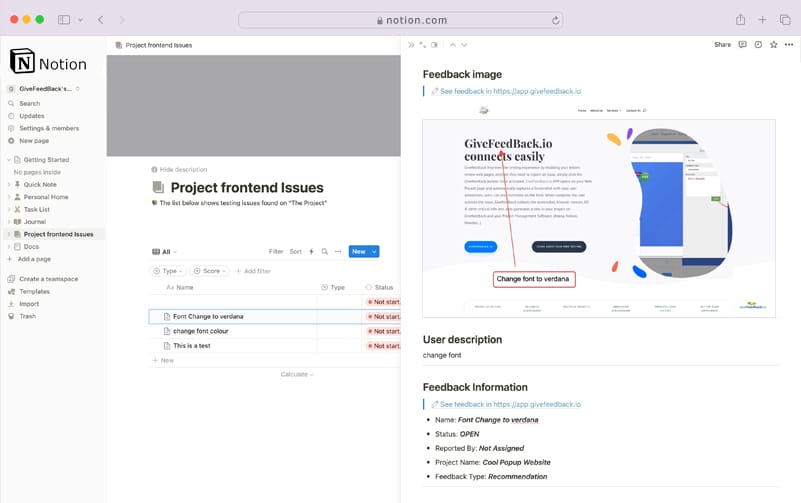
Your team then works in Notion as usual: the triage person sets Status, Type, Priority and Assignee, and the developer moves the card across the board. The client never needs a Notion account. More details are on the Notion integration page.
Notion is one of several integrations: reports can also go to Asana, Jira, Trello, ClickUp, monday.com, Wrike, Slack or Discord, or arrive by email. If your team is on Asana, see how to track bugs in Asana.
How do you keep a Notion bug tracker useful?
Spend about ten minutes a day on triage during review periods, use filtered views as the agenda for client calls, empty the high-priority list before launch and archive or move what's left after launch. A tracker is only as good as its upkeep; without a routine, the database turns into a list nobody trusts.
- Daily triage (10 minutes): open the Triage view. For each new page, set Type and Priority, assign it or merge duplicates. If a report is unclear, ask the reporter right away, while they still remember.
- Before each client call: filter by Reported by = Client and Status not Resolved. That's your agenda.
- Before launch: filter Priority = High and Status not Resolved. That list must be empty, or explicitly accepted by the client, before you go live. Our website QA checklist covers what else to check.
- After launch: archive the board or move the remaining Low items into a "Phase 2" view, so the database doesn't become a graveyard.
What does one report look like from start to finish?
A client reviewing a staging site notices that the newsletter button is cut off on their laptop. They click "Give Feedback", allow the tab capture, draw a rectangle around the button and write a title, a description and a type. A few moments later the report is a page in your Notion database, ready for triage.
Title: Subscribe button cut off Description: I can only see "Subscr". It should show the full word. Type: Bug
The page "Subscribe button cut off" appears in the database with the marked-up screenshot and "Windows 11, Chrome 129, 1280 x 720". Your project manager sets Priority = High and assigns it to the developer, who reproduces it at the same resolution, fixes the CSS and moves the card to Ready for review. The client checks the Client review view and confirms. No email was involved. For what makes a report like that useful, see our bug report template.
Is Notion the right bug tracker for you?
Notion works well as a bug tracker when your team already lives there, projects are websites rather than complex software and most reports come from clients and non-technical reviewers. It's weaker when you need code integration, release planning or detailed time tracking; then a dedicated tool is worth the switch. Our comparison of free bug tracking tools covers the options.
If Notion fits, import the template today, add the four views and connect GiveFeedback.io so the next review round fills the tracker for you. The Free plan includes the Notion integration; see pricing.
Frequently asked questions
Can you use Notion as a bug tracker?
Yes. Create a database with properties for status, type, priority, page URL and assignee, and add a board view grouped by status. It works well for small teams and agency website projects, where most reports come from clients. Teams that need release planning, code integration or detailed workflows usually prefer a dedicated tool such as Jira.
How do you import a bug tracker template into Notion?
Go to Settings, then Import, then CSV (or type /csv on a page), upload the file and create a new database. In the mapping step, set Status to a Status or Select property, Page URL to URL, Assignee to Person and Date reported to Date. Delete the example rows once you've seen how they work.
How do I get website feedback into Notion automatically?
Use a feedback tool with a Notion integration. With GiveFeedback.io you connect Notion through OAuth, share the feedback database when Notion asks which pages to allow, and choose it. Every report sent from your website then becomes a page in that database with the title, the screenshot, the description, the feedback type, the browser data and a link back to the report.
Do clients need a Notion account to report bugs?
Not if they report through a feedback button on the website. With GiveFeedback.io, clients click the button, mark up a screenshot of the page and send it without creating any account. Only your team needs access to the Notion database, and you can still share a filtered view with the client as a guest so they can confirm fixes.
Is the GiveFeedback.io Notion integration free?
Yes. All integrations, including Notion, are available on the Free plan, which covers 5 projects and 50 feedback reports with no credit card. The Pro plan costs €19.95 a month, or €199.50 a year (two months free), for up to 100 projects, with the same integrations.
Keep reading
Workflow
How to Use Claude Code to Fix the Bugs Your Clients Report
How to use Claude Code to fix bugs: what it needs from a bug report, how to connect it to client feedback over MCP, and how to review the fix before you resolve it.
- 7 min read

Workflow
Client Website Approval: How to Get Sign-Off Without Delays
Client website approval made simple: the 5 approval stages, a revision-limit clause, a sign-off email, a free website sign-off form (Word) and a checklist.
- 8 min read

Workflow
Asana Bug Tracking: Free Template and Annotated Screenshots
Asana bug tracking for website projects: a free CSV template, five ways to get annotated screenshots into tasks, and automatic tasks from client feedback.
- 8 min read
Collect visual feedback on your next website
Visual website feedback for agencies, freelancers and their clients.
Free plan - No credit card - Set up in minutes