
Asana Bug Tracking: Free Template and Annotated Screenshots
By GiveFeedback.ioUpdated 8 min readEspañol

Asana bug tracking works well for agencies and freelancers who already run their website projects in Asana, as long as every bug ends up as a task with the annotated screenshot and the browser details attached. The free CSV template sets the project up for you, and the five ways of adding screenshots range from dragging a file in by hand to having client feedback arrive as ready-made tasks.
What is Asana bug tracking?
Asana bug tracking is using an Asana project as the list of bugs for a website or app: each bug is one task, sections represent the stages a bug goes through and custom fields hold the type, priority and browser details. Asana has no dedicated bug feature, so the project structure and the screenshots inside each task are what make it work.
The screenshot matters more than anything else. An annotated screenshot is a capture of the screen with arrows, boxes or text that point at the problem. In a Downloads folder or a chat thread it loses its context; inside the Asana task it sits next to the assignee, the due date and the conversation, so the developer doesn't have to ask "which page was this?". The goal is one issue, one task, with the screenshot attached and the page and browser written down.
How do you set up an Asana project for bug tracking?
Import the template to create a project with four sections (Reported, To fix, In progress, Ready for review) and custom fields for type, priority, page URL, browser and OS, screen size and reporter. Then agree on one rule: every new bug starts in Reported, one person triages it daily and finished bugs are marked complete rather than moved to another section.
- Import the template: click the + button, create a new project, choose Import and select the CSV. Asana's CSV importer page shows the steps.
- Check the preview: Name, Description, Section/Column, Assignee and Due Date map to task fields; Type, Priority, Page URL, Browser and OS, Screen size and Reported by become custom fields. Custom fields need a paid plan, so on the free Personal plan leave those columns out.
- Switch to the board view: the four sections become columns. Keep Reported first, because new tasks land in the first section.
- Delete the examples: the four tasks show one per section. Remove them before the first review round.
| Custom field | Type | Values |
|---|---|---|
| Type | Single-select | Bug, Proposal, Recommendation, Feature |
| Priority | Single-select | High, Medium, Low |
| Page URL | Text | https://staging.example.com/cart/ |
| Browser and OS | Text | Chrome 129, Windows 11 |
| Screen size | Text | 1366x768 |
| Reported by | Text | Client, Tester, Project manager |
A few rules keep the project useful:
- One issue per task: if a client sends five problems in one message, split them into separate tasks or subtasks.
- Daily triage: during review rounds, one person goes through Reported, sets Type and Priority, assigns and merges duplicates.
- A clean launch list: before launch, filter Priority = High and incomplete. That list should be empty, or accepted in writing by the client. Our website QA checklist covers what else to check.
How do you get annotated screenshots into Asana?
Five, from fully manual to automatic: attach or paste them by hand, annotate attachments inside Asana with Proofing, email them to the project's address, collect them with an Asana form or let a website feedback tool create the tasks. The first four need someone to capture the screenshot and type the context; the fifth captures both automatically.
Method 1: Paste or attach the screenshot manually
The basic route works on every Asana plan:
- Capture and annotate: use Snipping Tool on Windows, Shift-Command-4 and Markup on Mac, or a desktop screenshot app. Our guide to annotating website screenshots covers the options.
- Create the task: in the right section of the project.
- Add the image: drag it into the task, attach it with the paperclip or paste it into the description or a comment.
- Write the context: the page URL, browser and screen size in the description.
Good for: your own team and a few issues a week. Weak point: every step is manual, and the URL and browser are the first things people forget.
Method 2: Annotate inside Asana with Proofing
Asana Proofing lets you open an image or PDF attached to a task, click on a spot and leave feedback. Each annotation becomes a subtask that you can assign and give a due date, according to Asana's help center.
Good for: design reviews of mockups and PDFs that are already in Asana. Weak point: someone still has to capture and upload the screenshot first, and Proofing is limited to the higher plans.
Method 3: Email the screenshot to the project
Every Asana project has its own email address in the format x+projectID@mail.asana.com (the project ID is the number in the project's URL). Send an email with the annotated screenshot attached: the subject becomes the task name and the body becomes the description. Forwarding to x@mail.asana.com creates a task assigned to yourself. Details are in Asana's email tasks help article.
Good for: turning client emails with screenshots into tasks without retyping them. Weak point: you can only create tasks in projects you're a member of (unless the project and team are public), so clients usually can't send to it directly, and one email with six issues becomes one task, not six.
Method 4: Collect feedback with an Asana form
Asana forms let anyone fill in a form whose submissions become tasks in a project. Add fields for the page URL, the description and a file upload for the screenshot, and share the form link with your client.
Good for: structured requests from people outside Asana. Weak point: the client still has to take, annotate and upload the screenshot and type the URL and browser. Many won't.
Which Asana plan do you need?
| Feature | Personal (free) | Starter | Advanced |
|---|---|---|---|
| Users | Up to 2 | No seat limit | No seat limit |
| Attach and paste images | Yes | Yes | Yes |
| Email to task | Yes | Yes | Yes |
| Forms | No | Yes | Yes |
| Custom fields | No | Yes | Yes |
| Proofing (annotate in Asana) | No | No | Yes |
| Price per user per month, billed yearly | $0 | $10.99 | $24.99 |
| Price per user per month, billed monthly | $0 | $13.49 | $30.49 |
Source: asana.com/pricing, as of October 2026.
How do you turn client website feedback into Asana tasks automatically?
Add a feedback button to the website with GiveFeedback.io and connect its Asana integration. The client clicks the button, marks up a screenshot of the page and adds a title and description, and each report becomes a task in your Asana project with the screenshot attached, the browser details in the description and a link back to the full report.
The four manual methods share one weakness with client feedback: a person has to capture the screenshot, annotate it, move it into Asana and add the context. For your own developer that's fine. For a client reviewing a website before launch, it means a PDF with arrows, a long email or a form that says "see attached" with nothing attached, and someone on your team spends an afternoon turning it into tasks.
With GiveFeedback.io and its Asana integration:
- Install the button: create a free project and paste the script into the site's
<head>; there are install guides for WordPress, Shopify, Wix, Squarespace and more. - Connect Asana: in the project's Integrations screen choose Asana, sign in and authorize GiveFeedback.io.
- Pick the destination: select the Asana workspace and the project where tasks should be created.
- Send the client the link: they click "Give Feedback" on the site, allow the browser to capture the tab, mark up the screenshot with arrows, boxes, text or a highlighter and add a title and description. No account needed.
Each report then becomes one Asana task with:
- Task name: the title the reporter wrote.
- Description: what the reporter wrote, followed by the browser data: screen resolution, operating system, browser and version, language and time zone.
- Attachment: the annotated screenshot, as a file in the task.
- Link back: to the report in the GiveFeedback.io dashboard, which also holds the page URL and the feedback type.
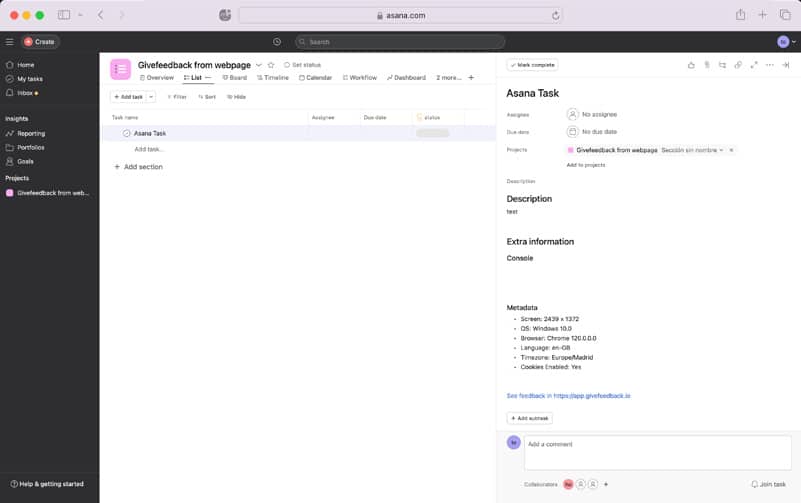
Your team then triages in Asana as usual: set the custom fields, assign the task and move it across the sections. If your team uses Notion instead, see our Notion bug tracker template.
Which way of getting screenshots into Asana is best?
For bugs your own team finds, paste screenshots into tasks and use Proofing if your plan includes it. For clients who email screenshots, forward them to the project address. For clients and testers reviewing a whole website before launch, a feedback button that creates the tasks is the only method where the context arrives without anyone typing it.
| Method | Who captures the context (URL, browser) | Client needs an Asana account | Asana plan | Effort per issue |
|---|---|---|---|---|
| Paste or attach | You, by hand | Yes, or you do it for them | Any | High |
| Proofing | You, by hand | Yes | Advanced or above | Medium |
| Email to project | You, by hand | Must be a project member | Any | Medium |
| Asana form | Client, by hand | No | Starter or above | Medium, for the client |
| Feedback button (GiveFeedback.io) | Automatic | No | Any | Low |
What does a good Asana bug task look like?
It has a name that says where and what, the section and assignee set, the type and priority filled in, a description with the expected and actual result, the page URL and browser, and the annotated screenshot attached. A developer can fix it without asking a single question.
Task name: Cart: checkout button text cut off Section: moved from Reported to To fix Assignee: Front-end developer. Priority: High. Type: Bug Description: "The button says 'Proceed to chec'. It should show the full text." Page: https://staging.example.com/cart/, Chrome 129, Windows 11, 1280x720 Attachment: screenshot with a red rectangle around the button
For the fields that make a report like this complete, see our bug report template. Set up the project from the template, decide how screenshots get in and, if clients review your sites, let them report from the site itself: GiveFeedback.io's Asana integration is included in the Free plan; see pricing.
Frequently asked questions
Can you use Asana for bug tracking?
Yes. Create a project where each bug is a task, use sections for the stages (reported, to fix, in progress, ready for review) and add custom fields for type, priority and browser details. It suits agencies and website projects well. Custom fields and forms need a paid plan, and teams that need code integration or release planning often prefer a dedicated tool such as Jira.
How do you import a bug tracking template into Asana?
Create a new project with the + button, choose Import and select the CSV file. In the preview, check that Name, Description, Section/Column, Assignee and Due Date map to task fields and that the other columns become custom fields, which need a paid plan. On the free Personal plan, leave those extra columns out of the import.
Can you annotate images directly in Asana?
Yes, with Asana Proofing: you open an image or PDF attached to a task, click a spot and leave feedback that becomes a subtask you can assign. As of October 2026, Proofing is part of the Advanced and Enterprise plans, not Personal or Starter, and someone still has to capture and upload the screenshot first.
How do I email a screenshot into an Asana project?
Every Asana project has its own email address in the format x+projectID@mail.asana.com. Email the screenshot there: the subject becomes the task name, the body the description and the image is attached. You can only create tasks in projects you're a member of, unless the project and team are public, so clients usually can't use it directly.
How do clients send website feedback to Asana without an Asana account?
Use an Asana form or a website feedback button. With GiveFeedback.io, the client clicks a button on the website, marks up a screenshot of the page and adds a description, and the report is created as a task in your chosen Asana project with the screenshot attached. The client needs no account in either tool.
Is the GiveFeedback.io Asana integration free?
Yes. The Asana integration is included in the Free plan, which covers 5 projects and 50 feedback reports with no credit card. The Pro plan costs €19.95 a month, or €199.50 a year (two months free), for up to 100 projects, with the same integrations.
Keep reading
Workflow
How to Use Claude Code to Fix the Bugs Your Clients Report
How to use Claude Code to fix bugs: what it needs from a bug report, how to connect it to client feedback over MCP, and how to review the fix before you resolve it.
- 7 min read

Workflow
Client Website Approval: How to Get Sign-Off Without Delays
Client website approval made simple: the 5 approval stages, a revision-limit clause, a sign-off email, a free website sign-off form (Word) and a checklist.
- 8 min read
Workflow
Notion Bug Tracker Template (Free) for Website Projects
Free Notion bug tracker template for website projects: import the CSV, set up the properties and board views, and send client feedback into Notion.
- 8 min read
Collect visual feedback on your next website
Visual website feedback for agencies, freelancers and their clients.
Free plan - No credit card - Set up in minutes